
The Story Her Grandfather Never Finished Telling Her.
4 minute read. It's the reason Le Petit Palais™ exists.

When I was a little girl, I used to hear stories all the time. My grandpa was a writer. He used to tell me, “Writing is beautiful. Writing is a way to empty some of the noise in your head that never seems to stop.” I never understood what he meant, that was until I got older.
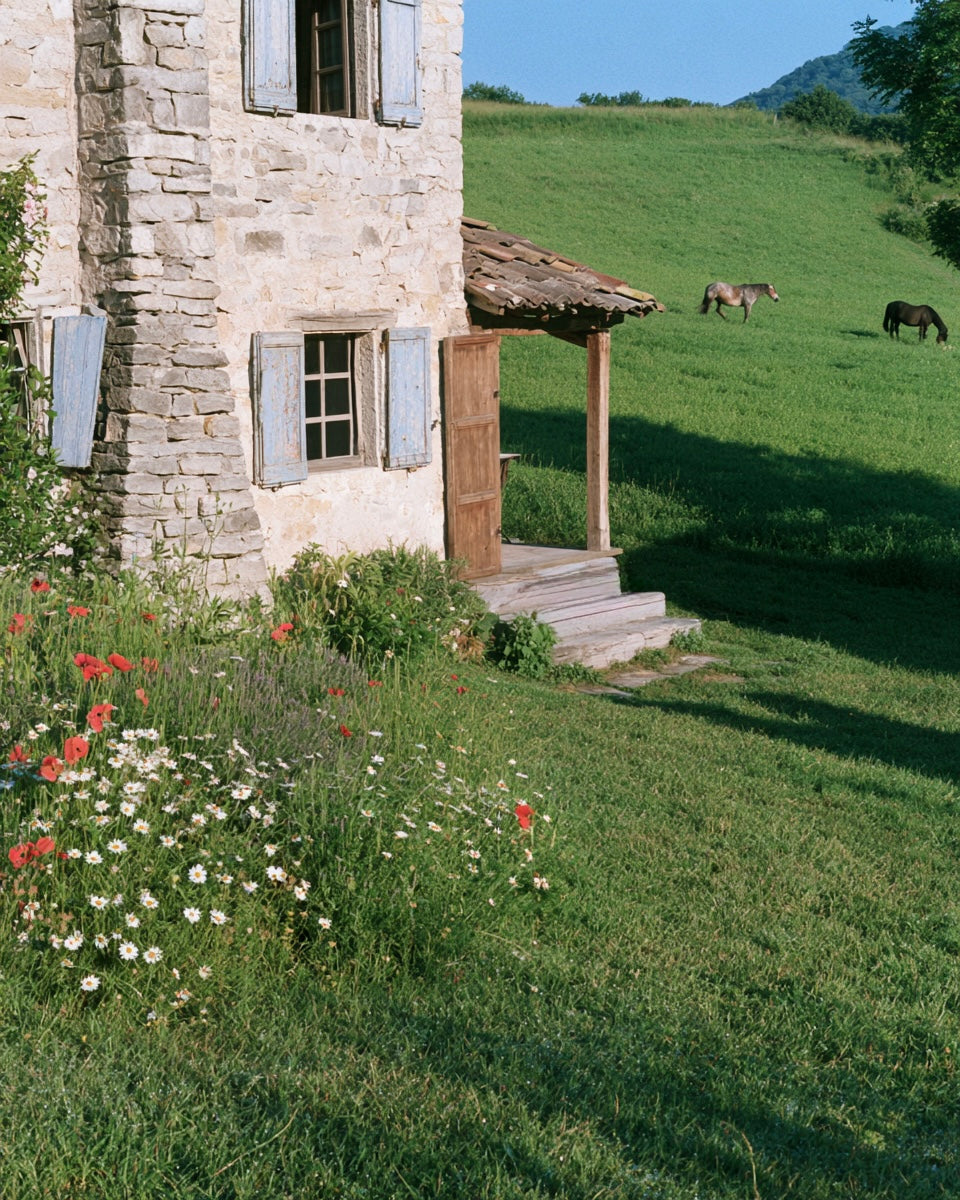
I lived alone with my grandpa in a small house in the countryside. Let’s not talk about my parents, this is not their story. Perhaps I’ll leave that for another time. Anyways, we had a wooden porch that creaked in the morning. A stone chimney that leaned slightly to the left. A yard that stretched out into rolling fields. Wildflowers in the summer, silver frost on the ground in the winter.
There were animals everywhere. Two old horses named Bijou and Rémi who lived in the little stable behind the house. A handful of chickens who ran the garden like they owned it. A stubborn goat named Colette who chewed through every fence my grandpa ever built. And our orange tabby named Louis. The one who slept curled up beside me every night while my grandpa told me stories.
Our house was the only one for miles. Just us, the fields, the animals, and the sky. It was peaceful in a terrifying way. You know that saying, the 'calm before the storm.' The countryside had a way of holding its breath. Sometimes for days at a time. And when it finally exhaled, it wasn’t gentle. It was the kind of storm that reminded you— even the greatest of us have to let go.
So the sky would cry, and cry.
As a little girl all I knew was the thunder was loud, and I was small. I’d hide under the covers, waiting for the sky to be happy again. Why can’t you be happy?
"You can't know the light, ma chérie, if you've never sat in the dark,” my grandpa would tell me.
So when the rain came down, we'd sit in the darkness together. Him in the wooden chair beside my bed. Me under the covers, Louis pressed against my chest. He'd turn off the lamp and let the storm fill the room.
He'd say we had to sit in the dark for a little while. That way, when the morning came, the sun would mean something.
My grandpa used to tell me stories about pirates, dragons, kingdoms. The kind that don't exist. The kind you fall asleep believing in anyway. But when the sky was crying, he only ever told me one.
He'd smile a small smile. The kind that isn't really for you. The kind that's for someone who isn't in the room.
Then he’d begin.
“Ma chérie. Let me tell you a story.”
There was a boy — long ago, in a small village outside of Paris. He was poor. His family was poor. He worked at the paper mills from the time he was a child. Long shifts, aching hands, the kind of work that turns your body old before your face catches up. He wanted to be a writer. He never told anyone. Especially not his father.
One night — he must have been sixteen, maybe seventeen — he came home from the mill exhausted. He'd worked a double shift. His hands were bleeding. He set his few coins on the kitchen table for his mother and turned to go to bed. But I guess the universe had a different agenda. His father was standing there, waiting for him.
His father had been drinking. He looked at the boy — really looked at him — and started to laugh. Not a warm laugh. The other kind.
“You think you're going somewhere, don't you?” his father said. “You think you're better than this? You're not. You'll die at that mill. Just like me. Just like my father did. That's all you're ever going to be, boy. Nothing.”
The boy didn’t say anything. He couldn’t.
His father stepped closer. He looked down at the few coins on the table. It was the boy's whole week, and pushed them off with his hand. They scattered across the floor.
“This isn't enough”, he said. It's never enough. “You come home with pennies and you think you get to sleep here? Eat our food? Use our roof?”
The boy still didn't speak. He couldn't make his mouth work.
His father grabbed his coat off the hook by the door and threw it at him. “Get out. Come back when you've made yourself into something. Don't come back if you haven't.”
His mother was in the kitchen doorway now, wiping her hands on her apron. She was crying, quietly. But she didn't move. She didn't say his name.
The boy picked up his coat off the floor. He walked past his father. Past his mother. Out the door. He didn't close it behind him. He didn't have the strength.
So he walked.
He walked all night. Past the mill. Past the village. Down the road that led toward Paris, because he didn't know where else to go and he didn't want to go home.
By the time the sky started turning gray, he was miles from anywhere. He'd never been so tired. So cold. So alone. He sat down under a bridge on the edge of the city, pulled his coat around him, and for the first time in his life he thought maybe his father was right. Maybe he was nothing. Maybe he was trash. Something the world had already thrown away and forgotten about.
And then he saw it.
A piece of cardboard, sitting in the dirt beside him. Probably scrap from one of the mills. The kind that got tossed out when it wasn't good enough to make into a proper box. Flat. Torn on one edge. Dirty. Useless.
He picked it up. He didn't know why. He wasn't thinking. He just wanted to hold something.
Thrown out, just like him.
He reached into his pocket and pulled out a small nub of pencil he always kept with him. And he started to write.
He didn't write anything important. He didn't write anything special. He just wrote. About the moon. About the way the paper mill smelled in the morning. About how tired he was.
He wrote until the cardboard was full.
He looked at it for a long time.
Then he lay down, tucked the cardboard against his chest, and he fell asleep.
The next morning, he woke up cold and hungry. But he knew where he wanted to go. There was a place in Paris he always went when he had nowhere else to be. Someone had told him once that the Mona Lisa was the only smile in Paris that never went away. So he'd started going to see her, every Sunday, because his own smile was gone and hers wasn't.
He walked into the Louvre that morning. Dirty, exhausted, hungry. He sat down on the wooden bench in front of the painting. He pulled out his piece of cardboard. He pulled out his pencil. And he started to write again.
He didn't notice the girl who sat down beside him. He didn't notice her at all. Until she said something.
“Are you writing on cardboard?”
The boy looked up.
She was maybe eighteen. Wealthy — you could tell from the way she was dressed. Silk gloves. A hat with a ribbon. Boots that had never seen a mud puddle. She wasn't supposed to be sitting next to a boy like him.
He was mortified. He almost got up and left. But then she smiled. And her smile was almost as warm as the Mona Lisa's.
“That's the most beautiful thing I've ever seen anyone do,” she said.
Her name was Margaux.
They met every Sunday after that. Same wooden bench. Same painting. Same time.
When she found out he had nowhere to sleep, she took him to a small guest cottage on her family's estate — one nobody used. She snuck him bread from the kitchen. She made sure he had a blanket. Her family never knew he was there.
For the first time in his life, he was safe.
And for the first time in her life, she was seen.
Weeks turned into months. And they fell in love the way people do when nobody else is watching.
Then one afternoon, in the middle of December, everything changed.
Paris was cold. But you know how they say Paris is best at Christmas — well, it's true. The city slows down. The Christmas lights are strung across every street. The rain turns everything gold under the lamplight. Strangers smile at each other in the streets. Bakeries fill the air with cinnamon and warm butter. It's the kind of time that makes you believe in things.
He was waiting for her on their bench. Same spot. Same painting. Same time.
But when she walked in, he could tell something was wrong.
She sat down beside him. She didn't take off her gloves. She didn't smile.
“Margaux?” he said. “What is it?”
She stared straight ahead at the Mona Lisa. She wouldn't look at him.
“My father sat me down last night,” she said. “He's arranged a marriage for me. A man from another family. Someone I've never met.”
The boy didn’t say anything. He just waited for her to say that she obviously wasn’t going to marry a man she had never met.
“The wedding is in the spring,” she said. “I'm being sent to meet him for Christmas. I leave in three days.”
He watched her hands shake in her lap.
“It was always going to happen,” she said quietly. “You knew that. I knew that. Girls like me don't get to choose. We were pretending, mon amour. We were always going to be a story we told ourselves.”
The boy sat with that for a moment. He almost believed her. That was the thing about being poor. You learned early to stop hoping for things. You learned to know your place.
But then he looked at her. Really looked at her. The way she'd looked at him that first Sunday.
Like he was worth something.
“What if we didn't pretend?” he said.
Margaux looked at him.
“What?”
“What if we ran away? You and me. Before the spring. Before any of it.”
She laughed. The kind that comes when you don't want to cry.
“Don't be delusional. It's not real. It's never going to be real. My father would find us. My family would find us. We have no money. You have no name. Where would we go?”
The boy reached into his coat pocket. He pulled out a piece of cardboard. Fresh. Clean. He'd been saving it.
He pulled out his small nub of pencil.
“That's what writing is for, my love. You put it on paper and suddenly it's real.”
He set the cardboard down on the wooden bench between them.
“So let's write it.”
My grandpa would stop right there. Every time.
He'd look down at me and smile. That same small smile. The kind that wasn't really for me.
"That's enough for tonight, ma chérie. It's time for bed."
"But grandpa —"
"Maybe another night."
He'd tuck the blanket around me. He'd scratch Louis behind the ears. He'd turn off the small lamp beside the bed and stand up slowly.
"Sweet dreams."
And I'd lie there in the dark — with Louis pressed against my chest and the thunder still cracking somewhere far away — trying to imagine what happened next. Every night I fell asleep making up my own endings.
That was the last time he told me that story.
He passed away a few weeks later.
And a few weeks after that I found an image of a boy and a girl.
They were young. Standing in front of a small stone cottage. A chimney behind them, leaning slightly to the left. Wildflowers growing in the garden. An orange cat curled at their feet.
The boy had his arm around her shoulder.
They were smiling like they'd been waiting their whole lives to smile like that.
It was my grandfather.
He was always the boy.
But that wasn't the part that made me stop breathing.
I recognized the house.
It was my house.
The house I grew up in.
The chimney that leaned to the left. The wildflowers in the garden. Louis on the porch.
I found a piece of cardboard, softened by time. It was the piece from the story. The one they’d written together in front of the Mona Lisa. The one that was never supposed to be real.
“A small house in the countryside. A chimney. A garden. Wildflowers. Two horses. A stubborn goat. An orange cat named Louis.”
I was living inside it.
I had been my whole life.
I found a letter beneath the cardboard. From my grandfather. It was dated the year before he died.
“Ma chérie,” he wrote.
My heart dropped.
“I never told you the ending because I couldn't say her name out loud. She passed away in the summer of 2001. In the house we built together. She was seventy-eight years old, and she was still the same girl who sat down beside me at the Louvre."
“I raised you inside our dream because I couldn't bear to let it die with her. I hope one day, you'll build one of your own.”
“Love always,”
“Grandpa.”
Le Petit Palais™ is his story, made real.
Every piece is handcrafted from recycled cardboard.
Every ornate baroque frame is a small tribute to the Mona Lisa — the only one who ever knew their secret.
For the boy who wrote his life onto cardboard. For Margaux. For everyone who was ever told their dream wasn't real.
99% of people spend their whole lives inside their own heads.
This is for the 1% who write it down.
— Boss & Coco


